Programs
A Long Walk Home has been working for over 20 years to empower young people to end violence against women and girls. Through innovative programs, we are leading a movement to end gender-based violence using art and activism for social change and healing.

Girl/Friends Leadership Institute
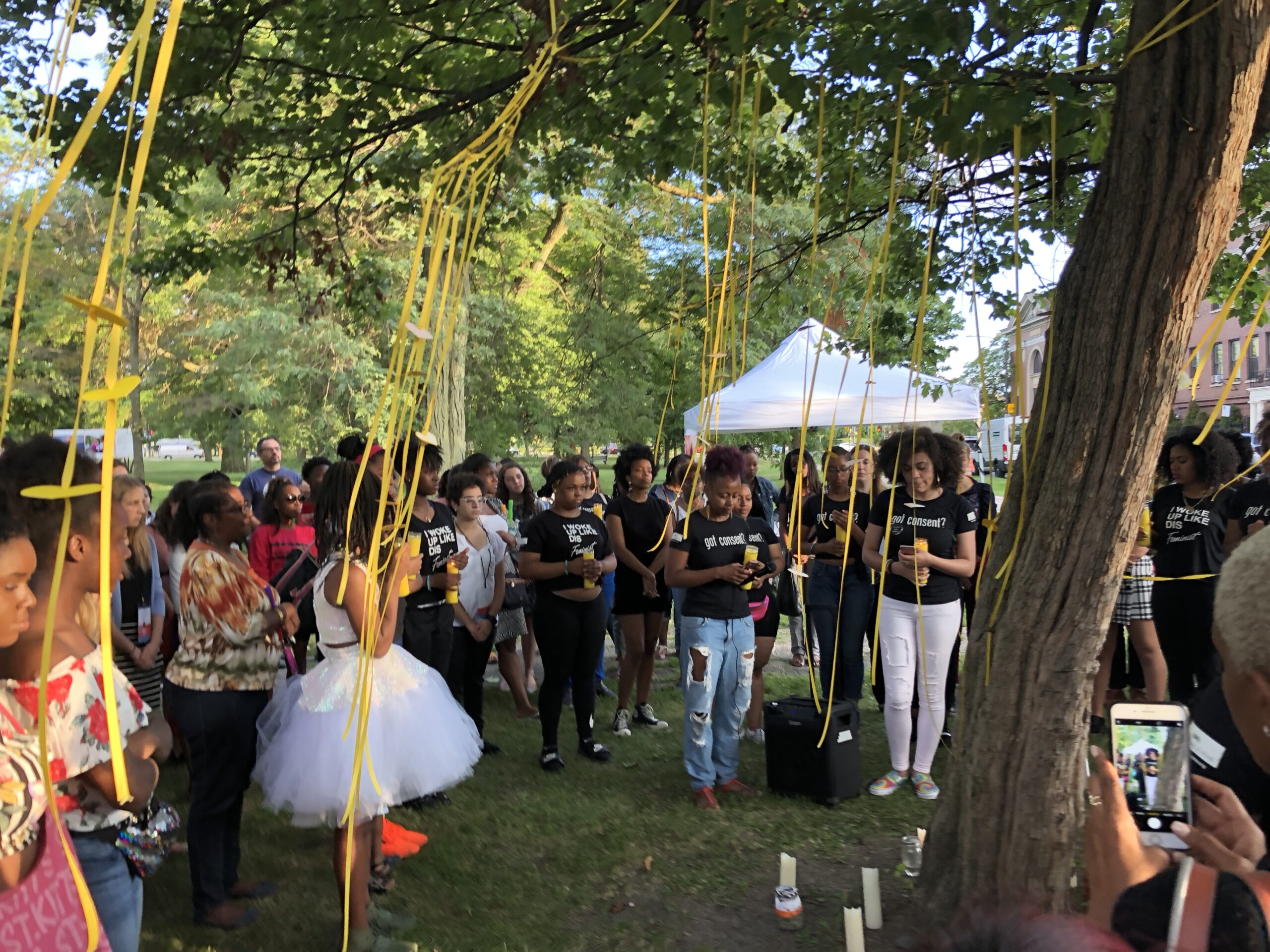
In 2009, A Long Walk Home (ALWH) established the Girl/Friends Leadership Institute, a two-year-long program that equips Black girls, gender-expansive youth, and young women in Chicago with the leadership, artistic, and activist skills necessary for driving change within their communities. The Girl/Friends program supports various girl-led and focused initiatives, including after-school programs, summer leadership institutes, culturally engaged therapy, parent engagement programs, alumni programs, art exhibitions, and research projects. A Long Walk Home has trained over six hundred Girl/Friends who have been instrumental in Chicago’s recent campaigns to end racial violence and gender inequality.
ALWH collaborates with The School of the Art Institute of Chicago to offer a six-week artist activist training program. This ten-year collaboration allows middle and high school students to explore art, pursue higher education, and earn college credits, with the goal of increasing and creating a pipeline for girls of color in the art world.
At ALWH, we firmly believe that Black girls and gender-nonconforming youth are leaders and are essential to driving social change. We are dedicated to supporting youth-led, community-based models that offer innovative solutions and address the root causes of violence that disproportionately affect girls. Our organization provides comprehensive training institutes designed to empower Black girls, strengthen their leadership abilities, and nurture their vision and strategies for enacting.
The Rekia Boyd Monument Project
A Long Walk Home’s (ALWH) Rekia Boyd Monument Project is a public art initiative honoring the life of Rekia Boyd, a 22-year-old Black woman killed by an off-duty police officer in 2012 near Douglass Park in Chicago’s North Lawndale neighborhood. Envisioned as a permanent monument in Douglass Park, the project celebrates Black girlhood, womanhood, and collective memory, using art to reclaim public space as a site of remembrance, healing, and possibility—challenging whose lives are memorialized and how cities tell stories about justice, care, and belonging.
The Rekia Boyd Monument Project follows more than a decade of public art activations in and around Douglass Park led by ALWH through its Girl/Friends Leadership Institute, in close partnership with the community-based public art organization Monument Lab. Beginning in 2009, Black girls and young women in North Lawndale and across Chicago engaged in public art, ritual, and advocacy rooted in the park, and in 2015 ALWH began working in close collaboration with Rekia Boyd’s family. This long-term, place-based work laid the foundation for a monument shaped not only by loss, but by leadership, imagination, and deep community relationships. At the heart of the project is a guiding question posed by ALWH and our partner, Monument Lab: How do we build a monument that commemorates Rekia Boyd’s legacy while celebrating Black girlhood?
Looking ahead, the project has entered a new phase of public creation. In summer 2025, ALWH and Monument Lab announced an open call for artists to collaboratively envision the monument while engaging Black girls and young women as citizen-artists in the process of building it. Five extraordinary artists—Nekisha Durrett, Tatyana Fazlalizadeh, Sonja Henderson, Nina Cooke John, and Tiff Massey—were selected to develop visionary proposals that memorialize Rekia Boyd and celebrate the brilliance, joy, and strength of Black girlhood; a finalist will be announced in spring 2026. Led by ALWH in partnership with the City of Chicago’s Department of Cultural Affairs and Special Events (DCASE), the Chicago Park District, and Monument Lab, the project is guided by a multidisciplinary Advisory Committee of artists, educators, architects, community leaders, and Rekia Boyd’s family, and is part of the Chicago Monuments Project, supported by a grant from the Mellon Foundation.

Black Girlhood Altar
During the uprising and global pandemic in 2021, A Long Walk Home’s Chicago-based artists Scheherazade Tillet and Robert Narciso created The Black Girlhood Altar. The Black Girlhood Altar is a multimedia, artifact-based, video, and object-based artwork to create sacred spaces and honor the lives of Black girls and young Black women who have gone missing or been murdered. As a mode of urgent healing – weaving together commemoration and advocacy – the Black Girlhood Altar is built on years of engaged work in Chicago and taking on national prominence. This temporary monument traveled through various neighborhoods and several prestigious venues, including the Museum of Contemporary Art Chicago, Project Row Houses in Houston, Project for Empty Space in Newark, the Minnesota State Capitol in St Paul, and the Chicago Cultural Center.
The Black Girlhood Altar honors eight Black women and girls: Rekia Boyd, Latasha Harlins, Ma’Khia Bryant, “Hope”, “Harmony”, Marcie Gerald, Lyniah Bell, and Breonna Taylor, whose deaths or disappearances have galvanized A Long Walk Home’s Black girl leaders to be activists and artists. In many cases, injustice defines their afterlives while their stories remain untold, their legacies honored by only a few.
Assembled by A Long Walk Home’s artists Scheherazade Tillet and Robert Narcisco and Black girls in Chicago, the altar is a mixed-media, object-based installation initially created during the pandemic to transform public spaces from trauma sites to collective remembering and power. The Black Girlhood Altar ignites crucial dialogues around the intersections of sexual and racial violence, shining a light on the systemic injustices threatening Black girls’ safety.

Courage Fund
The Courage Fund was spearheaded in 2023 by renowned writer and activist Ta-Nehisi Coates, in partnership with artists Salamishah Tillet and Scheherazade Tillet from A Long Walk Home, and activists Ted Bunch and Tony Porter from A Call To Men. The aim of the fund is to raise $10 million over the next ten years.
A Long Walk Home and A Call To Men have been at the forefront of the movement to end gender-based violence for two decades. The Courage Fund marks their first formal collaboration, focusing on culturally specific education, prevention programming, and public campaigns to influence cultural narratives and change attitudes.
The Ford Foundation contributed $1 million to The Courage Fund’s seed fund, with additional pledges from John Legend, Harrison Barnes, and others. This innovative fund is dedicated to raising awareness and providing vital resources for those committed to ending sexual violence against women and girls across the United States. Join us in this crucial effort to make a significant difference in the lives of countless individuals.

SOARS: Story of a Rape Survivor
Our unique framework of art, activism, and healing originated over twenty years ago with “Story Of A Rape Survivor” (SOARS), our award-winning documentary performance series created by Scheherazade photo-documented Salamishah’s journey to healing after she was raped twice in college. SOARS was an early trailblazer in its elevation of the voices of rape survivors of color, its education of the public about the epidemic of sexual violence in childhood and college and its in-depth focus on healing and recovery in the aftermath of trauma.
Over the span of 20 years, the Tillet sisters collected thousands of images that depict the intimate and challenging stages of a survivor’s path to recovery. The performance features a cast of Black women actors, dancers, and musicians, many of whom are rape survivors themselves, bringing these photographs, as well as Salamishah’s own poetry, private journal, and personal essays, to life on stage This performance, combining documentary photography, public disclosure, and Black feminist storytelling focused on healing from sexual trauma, was unique then and remains important today. SOARS toured rape crisis centers and college campuses for two decades over 300 colleges and universities.